US$1,000 less per tonne. Who measured it?
Half the poultry industry repeated that Chinese chicken costs US$1,000 less per tonne. Nobody showed the source. The uncomfortable part isn't China: it's how quickly we adopt someone else's number, and how rarely we check our own.
This week half the poultry industry repeated a number nobody measured.
Chinese chicken is US$1,000 per tonne cheaper than Brazilian and Thai chicken. You read it. Your manager read it. Someone has probably already said it in a meeting.
Where does it come from?
Who said it?#
One sentence. The general manager of Wintop Food, a Chinese processor from Shandong, said it to Reuters. A seller saying their product is cheap.
There is no price series behind it. It doesn't say which product, which cut, which destination or which date.
What does the other figure in the same report say?#
In the same report, a Lisbon trader gives a different number: Chinese breast and thigh arrive 10% to 20% cheaper than Brazilian.
Both can't be true for the same product. If US$1,000 were 20%, a tonne of Brazilian chicken would cost US$5,000. If it were 10%, US$10,000.
You know what a tonne of Brazilian leg quarters costs.
The headline that travelled was the US$1,000 one. This is how it spread (in Spanish).
What is actually measured?#
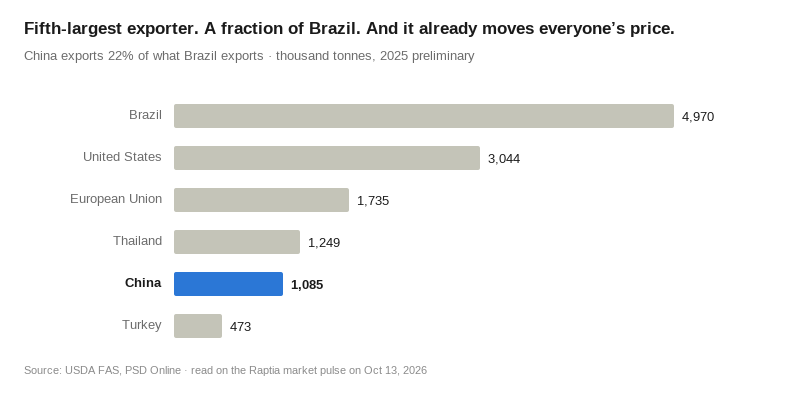
Source: USDA FAS, PSD Online · chicken meat exports 2025, preliminary · read on the poultry benchmark on October 13, 2026.
Fifth-largest exporter in the world. Less than a quarter of Brazil's volume. US$2.6 billion in 2025, almost double 2020, according to Chinese customs.
And it already moves prices. The Thai association of chicken exporters says its customers increasingly use the Chinese price as a reference point in negotiations. You don't need to sell much: it's enough for the buyer to have a number on the table. Even if nobody knows where it came from.
The uncomfortable part isn't China#
It's how quickly a company adopts someone else's number without asking where it comes from.
And how rarely it asks about its own.
What is your cost per kilo today, with the flock still in the house? Does your EPEF count thinning as mortality? A flock with 4.75% real mortality can show 23.97% from that single error, as we explained here. No number breaks. That's why nobody sees it.
If one sentence from a seller can push your price down, how sure are you of the number you have to defend it?
Has someone already put the US$1,000 on the table in a negotiation? Tell us who said it and what their source was.
And if you want to know what your last flock really says: free diagnosis.
Sources#
- Agrofy News — Surprise: Chinese chicken already costs up to US$1,000 less per tonne (in Spanish; headline cited as an example of how it spread)
- Times Brasil — Chinese chicken arrives 10% to 20% cheaper than Brazilian (in Portuguese, based on Reuters)
- Agrimídia — China turns its meat surplus into exports (in Portuguese)
- IndexBox — Wintop Food and the EU anti-dumping scrutiny
- Poultry benchmark, with USDA Foreign Agricultural Service data (PSD Online), read on October 13, 2026
Note: USDA's 2025 figures are preliminary. China's export value comes from Chinese customs and the volume from USDA; that's why they are not combined to compute a price.